Tuesday, August 1, 2023

Bodegas Otronia, Wines from the Very End of the World

Most of us are very familiar with the great Malbec wines that Argentina successfully produces and exports, but today I would like to direct your focus further south, to the province of Chubut, where very interesting wines are coming into shape.

This province of Chubut, in the Argentinean Patagonia, is located 2,000 km from Mendoza (the Napa of Argentina), its location at 45º latitude south puts this province at the very limit where viticulture is still possible. The province as we can see in the map below, is surrounded by the Andes in the west and the Atlantic in the east.

Here, near the town of Sarmiento and facing Lake Munster, is the location where Bodegas Otronia, a certified organic wine producer, planted 50 hectares of vines divided in two distinctive plots.

Of course, every great wine is the result of the perfect combination of a unique soil and climate. The climate in Chubut is very cold but also very dry and sunny, with an average yearly temperature of only 56º Fahrenheit and less than 200 mm of rain per year. Frost is often an issue, sometimes arriving in the middle of the growing season, and then, there are the raging winds, some as strong as 100 km/h coming from the Pacific Ocean that are truly felt in the vineyards. This happens, because the Andes that act as a barrier in Mendoza, where they reach well above 6,000 meters, reach only 700 meters in Chubut, allowing the winds to come through. In an effort to protect the vines from these fierce winds, Bodegas Otronia planted poplar trees all around their vineyards to shield them.  And then, there is the soil, a magic combination of 4 different ones, as the plots are located on what used to be the riverbed of a lake, featuring Lacustrine (lake clay) eolian sands, alluvial loams and fluvial and gravelly deposits from the Senguer river.


Location of the vineyards, photo courtesy of Bodegas Otronia.


During his visit to New York a week ago, Enologist Juan Pablo Murgia presented three of his wines, and explained in detail the uniqueness of the terroir behind them and how this translates into very focused wines with purity of fruit and elegant acidity.  A believer in minimum winemaking intervention, he ferments certified organic grapes with native yeasts in concrete egg- shaped containers, and ages his wines in untoasted French oak foudres that can contain 2,500 and 5,000 liters for 12 to 20 months. 

My 3 recommendations are the wines shown by Bodegas Otronia during their presentation. By the way, the winery’s name Otronia, means “land of Otron” which is the name that the natives used to give to Lake Munster.


*Otronia 45 Rugientes Corte de Blancas 2020, $39.95

Refined white made from a blend of 48% Chardonnay, 27% Gewurztraminer and 26 % Pinot Grigio. Murgia explained what each variety contributed to this blend, Chardonnay provides the texture and weight, Gewurztraminer the delicious floral notes and Pinot Grigio its vivid acidity. Very elegant indeed! A fragrant and crisp wine that boasts attractive jasmine floral notes, with citrusy lime and grapefruit nuances. Glossy on the palate with a mineral finish.


*Otronia Block I Pinot Noir 2020, $89.95

Ethereal red, featuring plush raspberry and bright red cherry notes with forest floor tones and super silky and spicy tannins. Memorable and delicious, made from fruit planted in Block I, where clay soils predominate.


*Otronia Block III and IV Chardonnay 2020, $89.95

Classy! This wine shows zesty acidity, a characteristic of fine cool climate whites, featuring juicy white peach and green apple peel with thyme and chamomile nuances. Simply delicious and mouthwatering with a persistent smoky finish. Very much reminiscent of fine Chablis and my fave of this trio. Cheers! Silvina


#thoughtsoflawina #drinkupamerica #Chubut  #winesofargentina #bodegasotronia

Tuesday, July 11, 2023

Four European Rosés to Beat this Summer's Heat!

In all 30 years that I have lived in the U.S. I have never experienced a hot summer like this one, the humidity of last week alone was just too much to bear! And what is better to drink to chill us up on dog days like these? an appetizing glass of rosé! Rosé is and will always be a summer staple, here are 4 delicious European samples sent by Taub Family Selections. All available nationwide and at $21 or less. 

Saget La Perrière “La Petite Perrière” Rosé 2022 (750ml/$13.99):
The same family that crafts outstanding and flinty Sauvignon Blancs, also produces this juicy and precise rosé from 100% Pinot Noir sourced from the Loire Valley. Fresh from start to finish, it features delicious red fruit notes that include cranberry and red cherry, combined with mouthwatering acidity and a touch of minerality.

Jean-Luc Colombo Cape Bleue Rosé 2022 (750ml/$15.99): Jean Luc and Anne Colombo, famously known for their superb Rhone (Cornas) reds make this savory Provençal rosé! It showcases a blend of 67% Syrah with 33% Mourvèdre. Elegant and very fruit forward, this medium-bodied wine shows watermelon, fresh strawberry, and pineapple candy notes, with a hint of sweet spice. Appetizing, with a long, pleasing finish.

Bertani Bertarosé 2022 (750ml/$17.99): Bertarose is made from the classic Valpolicella/ Amarone blend that includes Corvina, Molinara, Corvinone, and Rondinella grapes. This flavorful medium-bodied wine features the right balance of fruit and acidity, boasting plenty of white peach, sweet persimmon, and ripe raspberry notes. Vibrant with lovely length.

And finally, my fave, Planeta Rosé 2022 (750ml/$20.99): a Sicilian crisp Rosé, made from a blend of 50% Syrah and 50% Nero d’ Avola grapes. Delicious and expressive, this medium-bodied wine shows ripe wild strawberries, meringue and rose petal notes. Intense, it simply invites you to keep on sipping it, ideally under the stars! 

Happy Summer to everyone! Cheers, Silvina.

#rosewine #rosesummer #thoughtsoflawina #drinkupamerica #drinkrose

Tuesday, June 13, 2023

When in London, Drink Gin!

I still remember when I was only 10 years old and my mother took me to my first English class. Back then in Argentina, all the language institutes taught British English, so I learned by listening to tapes that my teacher played on a large boombox and tried really hard to repeat what we were reading in our books. All the stories took place in London, and as I read about the Big Ben, Hyde Park, Piccadilly Circus, Tower Bridge, and other tourist sites, I promised myself to visit one day. Last month, I finally did it, and as I was researching information about places to go and things to do during my visit, I thought about going to a Gin distillery (Beefeater) to learn more about Gin.

Let me start by saying that though the UK would like to claim that Gin was created there, Gin was truly born in the Netherlands. Gin is indeed a derivation of the word Genever, which means Juniper in Dutch. Juniper berries are the most important ingredient in any Gin’s recipe, giving Gins their special aromatics and flavor. 

But, what is Gin and how is it made? Gin is a neutral spirit that has been infused with botanicals, which must include Juniper berries but also other flavorings, such as seeds like Caraway and Coriander, spices like Angelica root or Licorice, Citrus peel, and or different herbs. The different blends of botanicals is what will differentiate one Gin from another, and here, pretty much the sky's the limit, since one can flavor Gins with any type of combination of flavorings obtaining a different product each time.


   Botanicals used at Beefeater's distillery to make their gins.

 
The exact date that Gin was created is not known but there is evidence of many Juniper flavored spirits in the Netherlands starting in the 13th century.  Gin landed in the UK, after William of Orange married Mary II and became King of England in 1689. Not only he brought Juniper flavored spirits to the English court but he also promoted their commercialization by lowering the taxes on Gin, and by imposing taxes on Gin’s competitors such as French wine and Cognac. Pretty soon, these policies influenced the British drinking habits and Gin became very popular and the favorite choice of the masses. By 1720, the UK experienced what is known as the "Gin Craze", not only people drank Gin all day long but also a quarter of houses produced homemade Gins. Those were also the days when a pint of Gin was cheaper than a pint of beer, and drunkenness in London was a big problem. Pretty soon things got so out of hand, the government was forced to intervene and they did so with the first Gin act, whose objective was to slow down production and consumption. The government raised taxes on Gin, and raised the cost of the licenses to produce it and sell it, as well as paying informants to bring illegal Gin producers to justice. Of course this was not easily accepted by the masses, and London experienced all kinds of riots and protests. At the same time London saw a multiplication of illegal distilleries that produced Gins that were very toxic for human consumption and that included turpentine and sulphuric acid, considered then flavor enhancers. Yet, consumption continued heavily until 1751, after that many distilleries closed down and consumption finally decreased. Gin was then replaced by another drink that is extremely popular in the UK today: beer.

Now, how is Gin made? The basis of Gin is a neutral spirit, which can be based on grains, potatoes, sugar cane or beets. The base spirit is obtained by passing the fermented juice through a continuous still.  The science behind distillation is very simple, because alcohol boils at 78ºc, a lower temperature than water, which boils at 100º c, this will allow us to make a distilled spirit by simply heating out the base. Alcohol then evaporates leaving all water behind, then it’s a matter of collecting those vapors, which are cooled down by condensation. This process is how all spirits are made, with most going through two or more distillations. The more times you distill the liquid, the more neutral the spirit will be and the higher the final alcohol in your product.  Once you have the neutral spirit or base, then comes the most important part in Gin, the infusion with the botanicals, which can happen in different ways. Traditionally, botanicals were infused by heat (similar to making tea), yet some producers also do a cool infusion, and others a vapor/ steam infusion that will provide lighter, more elegant flavors. The variation in the infusion style, as well as the botanicals’ secret recipes, is what gives each Gin their own personality. 

There are several styles of Gin, but the classic in the UK is known as London Dry Gin, which is used to make most cocktails. It is dry, light in body and very aromatic, with plenty of Juniper berry and citrus flavors. No sweeteners, botanicals or flavors can be added after the distillation is complete, only water is added to cut it down. Though labels include the word London on them, this is a reference to their style and not the location where the Gins are made, actually some London Dry Gins are made outside of London. Navy Strength Gins are made like regular London Dry Gins, but they contain higher alcohol, these Gins must have a minimum of 50% ABV vs 37.5% in London Dry Gins. They tend to be flavorful, as they contain less water and therefore are in a way more concentrated. Old Tom Gins, on the other hand, are sweeter styles thanks to the addition of simple syrup, licorice, or even honey. Contemporary Gins are Gins that feature other flavors than Juniper berries, such as vegetables like cucumbers, rosemary, thyme, etc and finally Fruit Flavored Gins are Gins infused with specific fruit flavors and in certain cases color, which is added after their distillation. Beefeater has a full line of these, featuring flavors that include: strawberry, cranberry, rhubarb, blackberry, etc.  

Most Gins are not aged, yet some producers have experienced aging some of their products in wood in an effort to offer a spin on the classic flavor.

My recommendations are two Gins I tasted at the distillery, which are also available in the US:

Beefeater London Dry Gin, $29.99
A classic staple, made in London following the same recipe created by founder James Burroughs in 1863. It features 9 botanicals that include  Juniper, Coriander seed, Angelica root, Angelica seed, Orris root, Licorice root, Seville Orange peel, Lemon peel and Almonds.

Beefeater 24 Gin, $39.99

A sophisticated recipe inspired by modern London. It features a blend of 12  botanicals (as shown as in London Dry Gin), plus the addition of exotic teas that include Japanese Sencha and Chinese Green tea. 

Sadly the other two samples I tasted during my visit: Beefeater London Garden and Beefeater Monday’s Gin are only available in the UK. If you are interested in paying them a visit, you can book your tour through their website.


Before I leave you, let me share another historical fact about the famous “Gin & Tonic” drink recipe and how it came to be. This well known drink originated out of necessity and in the navy, when it was discovered that the only remedy to fight Malaria was the consumption of Quinine. Quinine, the key element in Tonic Water, didn’t taste good on its own, so in order to make it more appealing to consumers, or I should say patients, it ended up being blended with some Gin. Here is the classic recipe:

Gin and Tonic:
1 part of your favorite London Dry Gin
2 parts preferred Tonic water
Lemon and orange wedges to garnish. 

Preparation:
Blend the gin, with the tonic water, add some ice, and a wheel of lemon or of orange, and give it a stir. Yum!!! so delicious and refreshing for summer. 

Until the next one, drinkupamerica! Cheers, Silvina

#thoughtsoflawina #gin #drinkupamerica #london #beefeaters #londondrygin.

Tuesday, May 16, 2023

Celebrity Wines

Once upon time, when I was just starting in the wine biz, one of my instructors told me that having/ owning a winery requires so much money that in order to do this, you basically needed to be rich or have received a huge inheritance. The truth is we are talking millions of dollars here, considering the money you will need to buy grapes or own vineyards, to purchase all of the machinery, hire staff to do the work, plus the money you need to spend to promote and market your brands, I'm sure you get the picture! It’s no surprise to me to see so many celebrities, who have the $$$$ to invest, venturing into making their own wine and spirits.

Now to the consumer, a celebrity’s name on the label doesn't always guarantee quality! but it does, in the case of the wines I recommend below, and this is mostly because of the celebrity’s commitment to make a great product.
In some cases, some celebrities are truly wine connoisseurs themselves and know exactly what they want in a wine and how to sell it, participating not only in the marketing of their brand, but also in the blend selection helping to determine their flavor profile. Others have retired from Hollywood for good, to become vine growers and producers themselves, embracing and promoting what every wine producer does, the terroir behind each of their wines and the love of the land. In any case, for the wine biz this is a win/win situation, not only a celebrity’s endorsement will sell the wines very well, but oftentimes their partnerships with local winemakers benefits entire appellations and countries too.

So, here are some celebrity wines that I have tasted lately and that I liked:


Sarah Jessica Parker
Known for playing Carrie Bradshaw in HBO’s Sex and The City and Divorce, Sarah launched her own wine line: Invivo X SJP in 2019, a collaboration with 2 New Zealand winemakers: Tim Lightbourne and Rob Cameron. 

Sarah’s line includes two wines: Invivo X SJP Sauvignon Blanc and Invivo X SJP Rosé, made in the south of France with the partnership of Vins Chevron Villete. My favorite is, of course, their Marlborough Sauvignon Blanc 2022, which retails for $20. Zippy and super refreshing, it features delicious notes of grapefruit, passion fruit and lime. Rounder, compared to other Marlborough wines, yet so fruit forward and intense, a wine to impress others for sure!

Brad Pitt
From Thelma and Louise, to Interview with the Vampire to the many Ocean 11 movies, Angelina Jolie’s ex ventured into the world of wine in 2012, when together the then couple, bought Chateau Miraval and its vineyards, in the south of France. The Jolie-Pitts joined forces with winemaker Marc Perrin, producer of renowned Rhone red Chateau Beaucastel, to make a very impressive lineup of Provence rosé and white wines. My recommendation is the entry level Chateau Miraval Rosé  2022, that costs only $26. It’s a blend of Cinsault, Syrah, Grenache and Rolle. This is a super elegant rosé  that showcases raspberry and wild strawberry notrd with ethereal minerality. They also sell Muse, a super rosé  that retails for $400.
After their much talked divorce, Angelina sold her shares to the owners of Stoli vodka, but Brad Pitt decided to keep his stake at the company.


Sam Neil
Famous for his role in the Jurassic Park movies, among many other films. Sam Neil has owned an organic winery in Central Otago, New Zealand since 1993. His brand Two Paddocks produces wines from two varieties: Pinot Noir and Riesling. Sam is very involved in the winemaking of his wines, as he was exposed to wine from a young age, because his parents and grandparents were wine and spirits merchants. He became a Pinot Noir enthusiast after tasting Burgundy while visiting France and soon after, he started collecting, when he resided in London. He makes an entry level wine called Picnic, and my favorite, which happens to be the winery’s flagship: Two Paddocks Pinot Noir 2021 $55, a medium bodied red that displays red currant and black cherry aromas, with earthy (truffle) and smoky notes. He also makes fancier single vineyard wines, but only in exceptional vintages.

Other celebrities making wines include Sting, Jon Bon Jovi, Francis Ford Coppola, Cameron Diaz, etc, too many for me to recommend. But as I tell my students, the only way to know about wine is to keep on tasting, as much as possible and as often as possible. So don't be afraid to give them a try, until next one! Cheers, Silvina.


 #thoughtsoflawina #celebritywines #drinkupamerica #invivosjp

Tuesday, April 11, 2023

The Wines of Argentina: Malbec and Torrontés

"Mi Buenos Aires querido, cuando yo te vuelva a ver, no habrá más penas ni olvidos…" says one of my favorite tangos by famous singer Carlos Gardel… what a way to start my post about wines of Argentina.

For a very long time, I wanted to write a post about my country, not only because these are the wines that my father, a true wine connoisseur, used to drink while I was growing up, but also because my family reads my blog, and though they may like and laugh at my stories and occasionally get bored reading about the technical side of wine, it will be good for them to finally be able to purchase some of the wines I recommend.

What to tell you about Argentina? The land of Tango, the land of asados (barbecues), of meat so tender you can cut your filet Mignon with your own fork. The land of dulce de leche and mate and of course, the land of Maradona and Messi, (we are the world champions after all!) but most importantly the land of Malbec and Torrontés.
Argentinians know their wines very well, they produce and drink plenty of it; Argentina is the 5th world producer and wine consumption is estimated to be about 36 liters of wine per person per year. Sadly, the wine we consumed in the past was not always of great quality; for a long time, we were very happy drinking simple quaffs, like Valmont tinto or Toro Viejo (per their website, it is still the second most popular wine in Argentina). But everything changed in the 1980s, when Nicolas Catena revolutionized winemaking in Argentina.  Nicolas Catena is our star winemaker, he was so convinced that Argentina had everything it needed to produce wines to compete with the very best in the world, he started a movement to improve the quality of the wines, by using stainless steel tanks and small French barriques for example, but he also experimented a lot in the vineyards, lowering the yields to obtain more concentration, planting Malbec at higher altitudes to attain more elegance and even creating his own Malbec clones. Today, his amazing work continues with his daughters Laura and Adrianna and with the Catena Institute, where they investigate soils, climates and techniques to produce the finest of Malbecs.

Of course to make great wine, you need to be blessed with ideal conditions. Over 225,000 hectares of vineyards are spread among 12 Argentinian provinces. But 2 of them are the most important, the first one is Mendoza of course! Located on the eastern side of the Andes mountains. Mendoza is the place to make wine in Argentina (our Napa), with more than 1,000 producers specializing in Malbec.  
The key element in Mendoza is the Andes that act as a barrier, providing extremely dry weather with very few rains (only 225 ml per year), good to prevent fungal diseases and have naturally healthy vines. Luckily, irrigation is allowed, with plenty of water coming in the form of melted snow from the Andes, but also some via drip irrigation or transported via channels.  Most of the vineyards are planted at high altitude, some of which can reach from 3,000 to 6,500 feet above sea level, keeping average temperatures between 60-70ºF, this allows sunny loving Malbec a long and slow growing season. Mendoza also has a variety of soils that includes: sand, gravel, clay and limestone, all well drained, poor and infertile, helping to keep yields low.  Also, of note is the pre-phylloxera clones, meaning that Argentinian Malbec clones were brought before phylloxera decimated the vineyards of Europe, this means these vines still have their vitis vinifera original rootstocks. 

There are five zones in Mendoza, the two most important are: Primera zona (1st zone) where the first Argentine vineyards were planted and home to some of the oldest wineries. It includes the subzones of Maipú and Luján de Cuyo. The second zone is the Uco Valley, in the south, that includes subregions such as Tupungato, Tunuyán and San Carlos, home to famous enclaves such as La Consulta and Paraje de Altamira. One of the things Malbec fans love the most is its delicious spicy dark fruit and supple texture, and the way it expands and coats your palate with its sweet and smooth tannins and natural fleshiness. So delicious, indeed!

The second most important wine province is Salta, located in the north west of Argentina. Though here, beautiful and sturdier reds are produced, the star of Salta is a white grape: the Torrontés Riojano, a cross between Muscat of Alexandria and Criolla grapes. Torrontés produces a very floral, concentrated and refreshing dry white (featuring similar notes found in Gewurztraminer and Muscat), showing flavors of rose petal, peach, lemon Meyer, citrus zest and geranium. Torrontés wines usually feature a medium to medium plus body with balanced acidity and high alcohol that goes between 13-14,5º %. Surprisingly and in spite of their sweet and floral aromatics, most Torrontés wines are dry and are best consumed when young and fresh. Now, the climate in Salta is even drier than in Mendoza, with very limited rains that keep yields low and  grape skins thick, a result of the extreme conditions. And guess what? The vineyards are even higher here than in Mendoza, featuring elevations up to 10,000 + feet, producing truly wines of altitude. The best vineyard plots are located in the Cafayate and Calchaquí Valleys. Besides Torrontés, Salta also produces wines from other varieties such as Cabernet Sauvignon, Syrah, Chardonnay, Merlot, Tannat, Malbec, Bonarda, Barbera and Tempranillo. 

Because Mendoza and Salta are so dry and sunny, one may fear of overripeness but this is where altitude helps, bringing elegance. With the years Argentinean producers learned to identify the best spots for Malbec and Torrontés and to give them the proper treatment at the winery, so that the wines express their true terroir. Their hard work and dedication is what keeps their quality getting better and better.

My Wine Recommendations: nothing gives more pleasure than to be able to recommend wines from my country, as there are so many good ones! Here are just some of new releases, I tasted lately:

Bodegas Colomé Torrontés 2022, Salta $14. This Torrontes comes from some of the highest vineyards in the world with altitudes that go from 5,000 to 11,000 feet. It’s full bodied with delicious acidity and very aromatic notes of rose, geranium and grapefruit. Refreshing, and ideal for Spring.

Tilia Malbec 2022, Mendoza $11. Committed to sustainability, Bodegas Tilia produces this 100% Malbec that shows delicious notes of blackberry marmalade, aromatic violet, and bitter chocolate notes. Medium in body with velvety tannins from brief aging in oak.

Tercos Malbec 2021, Mendoza $15. Medium bodied red showing stewed dark cherry and blackberry notes. Super silky tannins give away seductive notes of vanilla and cedar.

Bodegas Caro Aruma Malbec 2021, Mendoza $21. A joint venture of two wine titans: Domaines Barons de Rothschild (Lafite) and Nicolás Catena yielded this super round and creamy red with satin tannins and unctuous cassis, blueberry and plums notes. So inviting!

Susana Balbo Signature Malbec 2020, Mendoza $28. A classic from the top female winemaker in Argentina: Susana Balbo. This full bodied red displays ripe blackberries and blueberries blended with sweet tobacco notes. Very elegant with ultra fine tannins and juicy acidity.

Ben Marco Malbec 2020, Mendoza $22. Big and dense tinto showing opulent, sweet plum and black cherry notes, with a touch of dry herbs spiciness and a superb mineral finish. This is also produced by Susana Balbo. 

Ricardo Santos Gran Malbec 2018, Mendoza $34. Chewy and beefy Malbec, featuring prunes and plum aromatics with a touch of black pepper and balsamic hints.  This wine was aged for 24 months in French oak.  Very flavorful!
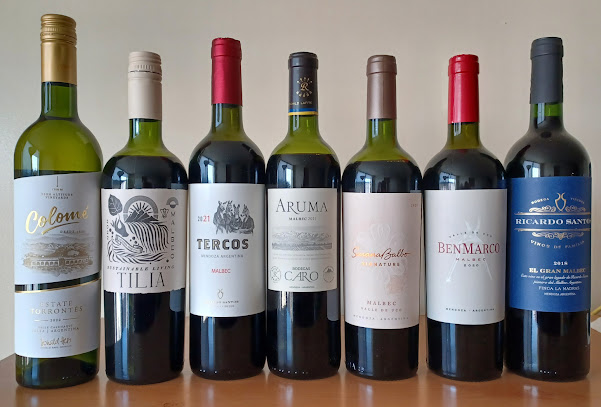
 

 Happy Malbec World Day to all! Cheers, Silvina

#winesofargentina #thoughtsoflawina #torrontes #malbec #internationalmalbecday

Remember to subscribe to receive Thoughts of La Wina in your inbox and to follow me on Instagram @:Silvinalawina.