Tuesday, January 24, 2023

Underdog Grapes: Tannat

Are you up to a challenge? This is what I propose you to do, next weekend, leave your cabernet,  merlot and shiraz that you like so much, and try a different red, like a wine made from Tannat.

Tannat is often considered an underdog red grape, mostly because very few people know about it, yet it has plenty to say.  Tannat makes some of the most powerful wines in the world, wines that are rich, flavorful, and tannic. Wines that thrive at all price ranges, with some very affordable samples starting at only $18, but also super premium quality at $30 and above.

Originally from Southwest France, Tannat is a main component of AOC Madiran wines. By law, traditional Madiran is usually a blend made from 60 to 80 % Tannat, complemented  by either Cabernet Sauvignon, Cabernet Franc or Fer.  Stylistically, Madiran wines were once known for being very powerful and rustic, requiring years in the cellar to soften their grippy tannins, but nowadays and thanks to destemming and to micro-oxygenation, Madiran wines are approachable sooner.  
 
Besides Madiran, Tannat does very well in another place in the world, and this is where I want you to focus today, in a tiny South American country called Uruguay. Uruguay, located to the south of Brazil and to the east of Argentina, has over 180 wine producers, and over 6,000 hectares of vineyards, 27% of which are dedicated exclusively to Tannat. 

Without a doubt, Tannat is the varietal flagship of all Uruguayan reds. Tannat is also known in Uruguay as Harriague, to honor Pascal Harriague, the Basque country pioneer, who was the first person to import cuttings of Tannat to Uruguay, in the late 1800s. Uruguayan vineyards, like those in Madiran, enjoy a similar mild maritime climate; though technically  located at the same latitude as Mendoza in Argentina or Maipo in Chile, Uruguay has a completely different terroir. For starters, there is very little altitude in their vineyards, with most of them planted on rather flat valleys, with some small hills that can reach up to 500 meters above sea level on their highest peaks. There are 6 distinctive wine regions in Uruguay but the two most important are located near the city of Montevideo, the capital of Uruguay.  
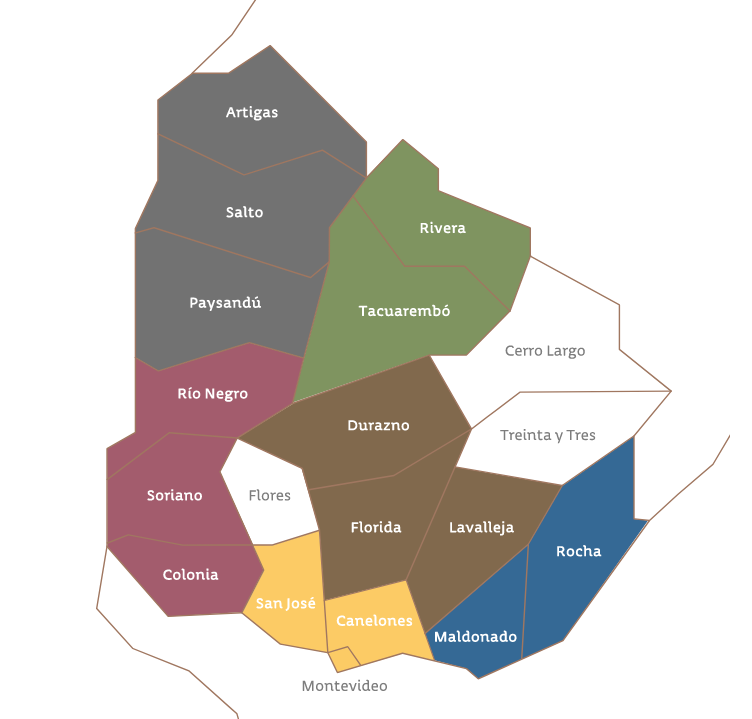
Map courtesy of Wines of Uruguay (Inavi).

Canelones is considered the very heart of all Uruguayan viticulture,  producing almost 73% of all Uruguayan wine, followed by nearby Maldonado that produces about 7%. These side to side areas are very much influenced by the Atlantic ocean and by two opposite currents: the Malvinas current that comes from the South and the Brazilian current that comes from the north, which bring plenty of rain (about 1000 mm a year). Uruguay’s climate is  warmer and very humid and very different from the almost desertic and dry Mendoza or cooler Casablanca valley in Chile. This maritime influence will leave a mark on the final wines that are more fruit-forward with balanced acidity and less aggressive tannins than their European counterparts. Like in Madiran, Uruguayan Tannat is also planted on soils rich in clay and granite with some patches of calcium carbonate compounds from sea shells. Most Uruguayan Tannat is sold as a single varietal, but it can be blended with other grapes, such as Pinot Noir or Merlot, I was surprised to receive a sample with some Viognier in the blend too!

Stylistically, Tannat yields a natural powerbomb wine: with a big body, plenty of acidity and structure from tannins, and these tannins you will surely feel on your palate, even when the wines have not been aged in oak at all. Tannat wines are almost black in color and display ripe black fruit flavors of black cherries, blackberries, black plums, licorice and tobacco. With aging they will show notes of leather, smoke, espresso, chocolate and cigar box. Their muscular structure will allow them to develop in your cellars  for 10 years or more.  

My Wine recommendations:
Before I dive into the wines I tasted recently, allow me to thank Global Vineyard,  the Inavi (Uruguay wine institute) and Creative Palate, for inviting me to a very informative Zoom seminar about Uruguay wines and for sending these wonderful samples.

Gimenez Mendez Alta Reserva Tannat 2020, $18
Made from 100 % Tannat, it shows delicious blackberry and plum notes complemented by milk chocolate hints. With very smooth tannins and lively acidity, this wine was aged for 9 months in a blend of both American and French oak.  

Marichal Reserve Collection 2019
, $20
Made from 100% Tannat grapes, from 25 year old vineyards. This seductive red reveals layers of jammy black cherry, prune and leather notes. Velvety, round and ample with a touch of spice from spending 12 months in oak.

Montes Toscanini Gran Tannat Premium 2019, $59

Super classic 100 % Tannat that yields rich blackberry marmalade,  spicy clove and  roasted coffee notes.  A nice integration of ripe fruit, acidity and tannins. Very elegant and structured, it was aged for 18 months in oak. Wonderful now, but has plenty of cellar potential and will only get better with time.


Alto de La Ballena Tannat, 2018, $24
A singular blend of 85% Tannat and 15%  Viognier (something that is done only in Uruguay). It delivers charming red fruits: raspberry and cherry with powdery cocoa and chalky tannins from aging in American oak for 9 months. Very yummy!

Pisano RPF Tannat 2018, $24
This 100% Tannat features savory plum, cassis and bitter chocolate notes that open up to a delicious and very powerful red. Robust with very balanced tannins and a beautiful and concentrated finish. It smells and tastes more expensive than its price tag!

Marichal Grand Reserve “A”Tannat 2018, $65
Massive and spectacular! This hearty red is made from 100% Tannat grapes from 40 year old vineyards. Grand Reserve “A” features cocoa, blackberry and prune notes with espresso hints. Very expressive and extracted, a Wow me Tannat for sure!


 Cheers! Silvina.

#thoughtsoflawina #WineWednesday #drinkupamerica #tannat

Remember to subscribe to receive Thoughts of La Wina in your inbox and to follow me on Linkedin and Instagram @: Silvinalawina.

Tuesday, January 10, 2023

Time to drink local, Time to drink Long Island Wines!

Only 85 miles separate New York from Long Island, making this wine region the closest one to home. I still remember one Memorial Day weekend, not long ago, when I decided to go over there to visit some of the wineries. I was impressed by the variety of grapes planted,  and especially with samples made from Cabernet Franc, Merlot and Chardonnay.

So, what is special about Long Island? It's a relatively young wine appellation and small. Vinifera varieties were first planted here by John Wickham in the 1960s, but the first commercial wines, made from Cabernet Franc and Cabernet Sauvignon, were produced 10 years later by the owners of Castello di Borghese: Louisa and Alex Hargrave.  
 
There are only three AVAs here, two were set up in the 1980s, the North Fork AVA, and the Hamptons AVA. The third and newest AVA, Long Island was set up in 2001. There are over 57 wine producers to visit, most of them, located in the northern fork, alongside route 25.
 

As we may see in the map above (courtesy of Long Island wines), both forks are surrounded by bodies of water, enjoying a similar tempered maritime climate like in Bordeaux. This is the main reason why we find many Bordelais vinifera varieties, including Cabernet Franc, Cabernet Sauvignon, Malbec, Petit Verdot & Merlot. The cool breezes from the Long Island Sound and the Atlantic Ocean have also proven fantastic to grow whites too, my favorites are Chardonnay (used to make sparkling and table wines), Riesling, Gewurztraminer, Chenin Blanc, Viognier and Sauvignon Blanc.

Of course and due to its northerly location, at the beginning I had my doubts, but soon I discovered that these areas receive plenty of sun during the growing season, which allows most red grapes to attain full maturity.  Soils here are mostly sandy loam, haven loam and silty loam, with excellent drainage. Now, if I have to describe Long Island’s wine style, I will describe them as a cool climate, meaning very focused wines, with medium to medium + bodies, crisp acidity and very nice aromatics. Note that the reds tend to be more elegant and for sure less alcoholic than wines from warmer regions.  
Most wineries produce all styles of wines from whites, reds, rosés and sparkling, here is a delicious selection (thanks to Maria Calvert), that showcase their ample versatility:

Sparkling Pointe Vineyards Topaz Imperial 2019, North Fork Long Island ($44)
I love this winery’s slogan, if it’s not Sparkling what is the Pointe? This method Champenoise sparkling is a blend of 50 % Chardonnay with 34% Pinot Noir  and 16%  Pinot Meunier. It spends two years aging sur lie.
 A refreshing and vibrant nose opens up to strawberry shortcake and ripe yellow peach notes. Pastry aromas, crisp acidity and a touch of minerality makes this a very flavorful bubbly.
 
Paumanok Vineyards Chenin Blanc 2021, North Fork Long Island ($29)
Made from 100% Chenin Blanc, this wine is completely fermented in stainless steel vats. Very expressive on the nose, showing a tropical bouquet of ripe pineapple and white peach, with citrusy lime on the palate. Medium bodied with lively acidity and an exotic finish.

RGNY Viognier 2020,
North Fork Long Island ($35)
Made from 100 % Viognier, this full bodied white reveals notes of apricots, mango and vanilla from aging in oak. Creamy and textured with balanced acidity. 20% of this wine was aged in second hand oak for 2 months.

McCall Wines Estate Pinot Noir 2015, North Fork Long Island ($30)
Made from sustainable grown 100% Pinot Noir. This elegant light-bodied red shows  aromas of red cherry, strawberry preserves, forest floor and clove. Juicy acidity is complemented very nicely by smooth and supple tannins.

Sannino Vineyard Cabernet Franc 2019, North Fork Long Island ($35)
If there’s one grape in the world that thrives in Long Island’s terroir, that is Cabernet Franc, so do explore them!. This medium bodied red meshes raspberry, savory dry herbs and pencil shaving notes. A very easy red to drink every night of the week.

Suhru Wines Shiraz 2021, North Fork Long Island ($25)
Last but not least, a blend of 77% Shiraz, 12% Teroldelgo and 11% Petit Verdot.
This almost full bodied red features blackberry and ripe plums notes with spicy black pepper and milk chocolate hints. This beauty was aged for 7 months in American oak. Savory!

Isn't it time we go local and drink some of these? If so, let me know your favorites. Until the next one! Cheers, Silvina.

#thoughtsoflawina #longislandwines #liwines #newsyorkwines #newyork

Remember to subscribe to receive Thoughts of La Wina in your inbox and to follow me on Linkedin and Instagram @: Silvinalawina.

Tuesday, December 13, 2022

Boizel: Your Champagne for the Holidays!

Boizel, a six generation family enterprise, was founded in 1834 by a couple of local pastry chefs, Auguste Boizel and Julie Martin, who ventured into the Champagne business, after Julie inherited vineyards in the cities of Avize and Etoges.

The Boizel Champagne house, a negociant-manipulant, first sold their Champagnes locally, becoming one of the first houses to make and sell brut (dry) Champagne. Soon, their fame crossed all borders, first to the UK, then to Australia, Belgium, Germany, the Netherlands and NY. Boizel created their first Blanc de Blancs in 1929, and the Joyau (Jewel) line up in 1961. Their prestigious Cuvée "Sous Bois" (in wood) was released in 1990, and it was the first Champagne to be partially vinified in Burgundian second hand oak barrels. A practice that the winery still applies to 10% of their top wines today.

To make their wonderful line up, Boizel sources fruit from 7 hectares of their own vineyards located in Champagne's Avize and Le Mesnil-sur-Oger, these are complemented with fruit sourced from local growers. Their vintage wines are all aged in their cool, chalky cellars located underneath their tasting room in Epernay. The length of their aging varies according to each style, most of the NV wines are aged for 3 years, the Blanc de Blancs and Blanc de Noirs from 3 to 4. Vintage wines for up to 10 years while the Joyau de France line is aged for up to 15 years.

Boizel's Atelier 1834 entrance, their tasting room at Epernay, located at 46 Ave de Champagne.


Besides vinifying their wines in oak, I was surprised to find out that Boizel Champagnes have more Pinot Noir in their blends than any other champagnes (at least 50% or more vs the 33% usually found in other brands). This is true for most of their bottles including the NV, and except for their Blanc de Blancs, which is made solely from Chardonnay. Having a higher percentage of Pinot Noir, makes a huge difference in style, resulting in rich and bigger, yet more elegant Champagnes. 


Last July during my vacation in France, I had the opportunity to visit Atelier 1834 (Boizel's tasting room), where I tasted samples of their wonderful line. I highly recommend you to stop by and give them a try, you can find information to book their tours here.

Here are my recommendations: (special thanks to Marine Chantepy, Martin Sinkoff and Lydia Richards for making my visit/tour possible and providing information and pictures for this post).

Boizel NV is a blend of 55% Pinot Noir, 30% Chardonnay, and 15% Pinot Meunier. This NV Champagne is aged for 3 years on its lees and it includes 30% of reserve wines from the two previous vintages to keep consistency. So classy and elegant! with a lively mousse featuring white peach and yellow apple notes with hints of pear tart and honeysuckle. $60.99


Boizel Rosé NV is a blend of 50% Pinot Noir, 30% Pinot Meunier, and 20% Chardonnay. This NV Rosé is aged for 3 years on its lees and it includes 20% of reserve wines from previous vintages. Expressive and well knitted sparkler, reveals strawberry and white cherry notes with fresh raspberry sorbet hints. Very bright with a lively mousse and silky finish. $71.99


Boizel Blancs de Blancs NV is made from 100 % Chardonnay, sourced from top cru locations: Chouilly, Les Mesnil sur Oger, Cramant and Vertus. This Champagne is aged for 4 years on its lees and includes 40% of reserve wines in its blend. This creamy and textured Blanc de Blancs meshes lemon curd and pink grapefruit notes, mixed with smoke almonds and spicy ginger hints. So sophisticated, it invites you to keep on drinking! $83.99


Boizel Blanc de Noirs NV is made from 100% Pinot Noir sourced from top locations that include: Cumières, Mailly and Les Riceys. This wine is aged for 3 years on its lees and the blend includes 30% of reserve wines from previous vintages. A harmonious combination of minerality and texture, featuring apricot and pineapple aromas with fine pastry and hazelnut notes. Unfortunately this wine is not yet available in the US. $N/A


Boizel Vintage 2012 is a blend of 50% Pinot Noir, 40% Chardonnay, and 10% Pinot Meunier. Produced only in the best vintages, 3% of the blend is vinified in used oak casks. This rich Champagne is aged for 8 years on its lees and reveals aromas of white flowers, yellow plum and ripe peach with biscuit notes and orange preserves hints. So rich, yet mouthwatering. $100.99


And finally the Jewel of Boizel, Boizel Joyau de France 2008, featuring a blend of 65% Pinot Noir and 35% Chardonnay. 10% of this blend is vinified in used oak casks. This wine is aged for an average of 12 years on its lees. Mineral driven, the nose reflects extraordinary complexity, showing yellow peach, candied orange peel, blended with marzipan and brioche notes. Its superb elegance shines through its polished finish. I'm out of words, since this is simply spectacular! $158.99


Once again, thank you Boizel and Taub Family Selections! Happy Holidays and Happy 2023 to all! Cheers! Silvina


#thoughtsoflawina #WineWednesday #Boizel #Champagne #Holidaywines #DrinkupAmerica.


Remember to subscribe to receive Thoughts of La Wina in your inbox and for more recommendations, follow me on Instagram @Silvinalawina and Linkedin.

Tuesday, November 8, 2022

Microbiology and its important role in Wine Fermentation

During the pandemic I attended many webinars organized by my school, WSET/London. One of them caught my attention particularly, because it was about the important role that microbiology plays in wine fermentation. This seminar was presented by Ann Dummont, a Microbiologist from Lallemand Oenology. Her explanations not only satisfied the “wine nerd” in me but also helped me understand the winemaker’s intent behind each wine. 


Take any wine that you like for example, do you truly believe its creation was a pure accident? Probably not.

The winemaker decided to create this style of wine, he/she gave this wine form and shape from the raw materials to the bottle. Every step was meticulously planned and prepared to create a specific result. And the use of specific yeasts and wine bacteria played a very important role not only affecting the quality and style of this wine but also its shelf life.


Every fermentation requires two key ingredients, ripe grapes (with enough sugar) and wine yeast, also known as saccharomyces cerevisiae. If the winemaker decides to also put the wines through malolactic fermentation, bacteria is also needed, specifically oenococcus oeni and lactobacillus plantarum. Their job is to soften malic acid into lactic acid, yielding a softer/ rounder wine, with less acidity. 


There are two schools of thought regarding fermentation, those that follow and use spontaneous fermentation, with indigenous yeasts and those that use inoculated fermentation with lab created yeasts. Spontaneous fermentation is like a roll of the dice, or like leaving everything to chance, by simply allowing nature to take its course. Pro-spontaneous fermentation winemakers are proud of being so “natural”, of using indigenous yeasts found mostly in the wineries, brought by insects, in wine making material, grapes and skins. They are always defending the funky aromas and flavors of some of their wines, which according to them can only happen during a spontaneous fermentation. But, when you make wine commercially, is it smart to relinquish control over the whole fermentation process?  I guess, much depends on your tolerance to risk. This is why most wineries take the second path, that allows less risk by using inoculated fermentation. Here not only you have control of the whole fermentation process, and therefore the resulting wine, but you also reduce the chances of deviating from your objective, which is to make a sound wine that has no faults.


Now, the microbiological population varies through the different stages of fermentation, as seen in the graph courtesy of Lallemand Oenology. At the beginning and inside the berry, we find mostly non-fermenting oxidative flora, when the fermentation takes place, the balance changes, the oxidative flora diminishes greatly,  and the fermenting species, the saccharomyces cerevisiae prevail. The process will continue even during aging with further changes. 


  (graph used with permission of Lallemand Oenology (adapted from Renouf, 2016)

So, at the beginning of fermentation, non-saccharomyces cerevisiae will be present in higher numbers, but as the alcohol levels begin to increase, saccharomyces cerevisiae will take over. That is the path you want to take to a successful wine fermentation. If on the other hand non-saccharomyces cerevisiae are allowed to dominate, not only you will have problems in finishing the fermentation and getting a dry wine but they also can create faulty flavors that should be avoided.


Using inoculated/selected yeasts is not only important to control spoilage microorganisms, it also aids to express varietal and terroir typicity and to develop certain wine styles.  There are about 300 commercially available lab yeasts, many created on demand, some of them are better for certain styles, say red or for white wine or sparkling. Using inoculated yeasts, can help to increase acidity and freshness for example, or help the development of certain aromatics compounds, reducing sulfites and volatile acidity.


Of course, those in favor of spontaneous fermentation may say, inoculated yeasts will never provide the same flavors in a wine, than natural yeasts. But I disagree, inoculated yeasts, though created in labs like Lallemand, were also taken from wineries, from their vineyards and plots, and put through a 3-10 years rigorous selection process, whose main objective was to create a certain specific wine style, in a way, they customize the final product, providing in the process, many of the wine aromatics we like so much. Cheers! Silvina


 #thoughtsoflawina, #winefermentation #inoculatedyeasts #winewednesday#spontanousfermentation  #drinkupamerica


Remember to subscribe to continue receiving Thoughts of La Wina in your inbox and follow me on Instagram and on Linkedin.


Monday, October 10, 2022

Terroir and Soil

The French say that every great wine is born in the vineyards and that is the result of good viticulture and vinification practices used to express their terroir. 

But what is terroir? And isn’t it the same as soil? And the answer is NO.

Soil is just one element in the concept of terroir, and indeed a very important one. But terroir is not just the soil, terroir is a bigger concept that includes soil, climate and their relationship with the grape varieties. Of course, this is a very simple definition of terroir, since there are many factors that must be considered; for example, climate includes not only the mesoclimate (climate patterns of the vineyard but also the microclimate, climate of the vine), and let’s not forget the weather that changes every year, and hence the importance of vintages, varying according to the amount of sun the vines receive, the amount of rain, humidity, winds, frost, etc. 

The concept of soil includes several things, among them, its texture, its capacity to hold water, its structural and mineral components of both the topsoil and subsoil, its altitude, the steepness/ inclination of the slope, its ability to retain heat and to aid ripening, and how both climate and soil relate to the grape varieties, since each variety has different needs; some do better in cooler and sunnier weather, while others need extreme heat and very little rain. 

Terroir is, in a way, how these three elements interact, which will eventually lead us to conclude that no vineyard site was created equal, and that there might be differences, even within a vineyard. Terroir is also the basis of the French Appellation d'Origine Contrôlée system, created to protect origin as well as wine typicity.


Beautiful shot of stony soils that aid ripening by reflecting the heat they receive from the sun.


In the New World, the concept of terroir is not so important, New World countries worry more about climate. Soon they realized that copying the styles of the French was not always so easy.  For example, comparing latitudes between both hemispheres didn't yield the same results, and this is because the northern hemisphere is warmer than the southern, in part because its mass of land is bigger, but also due to the influence of the gulf stream. 


New World wine growers have definitely, more freedom to choose where to plant, but they need to find the right spot and then make an effort to keep the balance. Each vine grower knows that they need to work with nature, in order to get all of the goodness that nature is capable of giving. On the other hand, in the Old World, the concept of terroir reigns, and wine growers throughout history dedicated a lot of time to find out why certain vineyards give better wines than others, and how someone could or could not duplicate this phenomenon.

Regarding soils, and specifically those dedicated to viticulture, there are some common factors that can aid the wine grower to get optimal fruit ripeness:  

  • Most vines like well drained soils and having easy access to water. Depending on the climate, vines may prefer a cold soil (to delay ripening and therefore favoring acidity in wine) or a warm soil that can speed ripening and encourage earlier budding. Now, we must be careful with the amount of water, since too much will increase vigor and excessive growth of shoots and leaves that will generate shade and therefore fungal diseases. Too little water, creates the opposite, shutting the plant out. In hot climates, soils help prevent evaporation, for example the white Albariza in Jerez, forms a crust that helps the vine, survive hot and very dry summers. This is very important in appellations where irrigation is not allowed by law.
  • The color of soils are important, dark soils are warmer and aid ripening, giving lusher fruit and flavors than light colored soils. Texture and friability are also important, dense soils are late ripening and will give more herbaceous flavors, while loose, stony soils are early ripening and will give fruit forward flavors.
  • Nitrogen content is important, too much nitrogen can be bad, since the vine will produce large amounts of leaves and shoots, instead of focusing on the fruit. Nitrogen also affects the way yeasts metabolize musts.
  • Too much potassium content must be avoided, since it can reduce precious wine acidity.  Of course, the wine grower can work the soil to keep its balance. Calcium in soils, on the other hand, increases the pH (acidity) producing fresher wines.
  • High levels of organic matter are to be avoided. Contrary to popular belief, what works for other fruits and vegetables, doesn’t work for viticulture. Too fertile soils are not something to look forward to, since they produce excess vigor in vines, and favor roots that grow sideways. Very infertile soils are better, because they encourage the vines to go deeper in search of nutrients and minerals, as well as a water table. It’s said that vines grow where nothing else grows and that some stress (always avoiding extremes) will yield very concentrated wines.

Now, every time I write about an appellation, I indicate the contribution of its soils in the style of the wine and how it affects the final product. Of course, the anti-terroirists usually would say that the wine is the result of winemaking and that nobody can taste the soil in the glass. But I disagree, certain wine flavors come from the soils, such as the smoke present in the wines of the Mosel (from slate rich soils), or minerality present in the wine of Priorat (from llicorella soils) and for this reason only, I listed some of the most important soils below and what they provide to the wines we’ve grown to love so much.

  • Limestone soils give wines with high acidity and that are very aromatic, they also retain water in dry conditions, we can find this soil in the regions of Champagne and Burgundy. 
  • Clay soils are cold soils but poorly drained and at times dense. They give wines with fuller bodies. Pomerol and St Emilion have clay soils which are good for early ripening Merlot. 
  • Granitic soils are acidic soils, warm and minerally rich, they also reflect heat and aid ripening, a sample of these are the soils in the Beaujolais Crus.
  • Gravel soils are well drained and acidic and therefore give grapes with low acidity. A better combination will be gravel with limestone giving wines with more acidity and elegance. Like those in the Left bank of Bordeaux (Pessac-Leognan, Paulliac).
  • Flint soils are soils rich in silica, they reflect heat and are good for ripening, we can find these soils in the Loire Valley. They also provide their typical goût de pierre à fusil nose.
  • Marl soils are calcareous soils that are cool and delay ripening, favoring acidity in wines. Marl soils are found in Chianti (Galestro).
  • Schist and Slate are rocky soils, they are warm soils, made of fragmented rocks, they usually drain well, retain heat and aid ripening. Mosel in Germany, known for its cool and marginal climate, is rich in slate soils. 
  • Sandy soils usually drain well and retain heat, a sample of this soils can be found in Santa Barbara, California. They are also acidic soils but yield less aromatics than granitic soils.
  • Volcanic Soils: are rich in sediments and minerals and give complex, ample and fleshy wines. We can find volcanic soils in the Canary Islands, Yarra Valley and Oregon’s Willamette valley.

Until the next one, Cheers! Silvina


#thoughtsoflawina #wine&soils #terroir #WineWednesday #drinkupamerica 

Remember to subscribe to receive Thoughts of La Wina in your inbox and to follow me on Instagram @: Silvinalawina and Linkedin.