Showing posts sorted by date for query tempranillo. Sort by relevance Show all posts

Tuesday, July 21, 2026

Wines to survive el Niño weather

Whenever el Niño weather arrives, like the summer we’re experiencing in 2026, it feels as though the heat turns up the volume. Temperatures climb, heat waves linger, and those warm, humid days that seem to follow you everywhere, change everything, including the wines you crave. 

Let’s face it ! This is not your typical summer. The intensity of  El Niño weather forces us to reach for wines that refresh, revive, and invite us to slow down. For wine lovers, it usually means one thing: it’s time to open bottles that are chilled, bright, and made for warm-weather sipping, wines that bring instant relief on a hot afternoon, that make every summer moment feel a little easier. 

And of course, what spells summer better than rosé? This beloved wine remains the unofficial drink of the season, and its popularity shows no signs of slowing down. Rosés stand out for their freshness, versatility, and distinct sense of place, offering everything from delicate floral aromatics to vibrant, fruit-forward expressions in every sip.  Like the following samples below:

Amalaya Rosé, Calchaquí Valley 2025, Salta – $11.99

A blend of 95% Malbec and 5% Torrontés, this juicy rosé reveals aromas of wild strawberry, raspberry, and watermelon, lifted by delicate rose petal notes. The palate is fresh and expressive, delivering vibrant red fruit with crisp acidity, culminating in a bright finish. 


Marqués de Cáceres Rosé 2025, DOC Rioja- $12.99

Made from 100% Tempranillo sourced from vineyards in Rioja Alavesa and Cenicero, this silky rosado reveals layers of ripe strawberry, red cherry and raspberry, lifted by a subtle hint of citrus. On the palate, it is smooth and fruit-driven, lively acidity carries through a long, poised finish. 


Mathilde Chapoutier Orsuro Rosé 2025 AOP Côtes de Provence- $19.99

Lovely rosé made from a blend of Grenache Noir, Cinsault, Syrah, and Rolle, this wine opens with aromas of ripe strawberry, pink grapefruit, yellow peach and fragrant Mediterranean herbs. Full-bodied yet refined, it is expressive, balanced, and elegantly structured. 


And while rosé may steal the spotlight, summer whites deserve their moment too. For me, the ideal warm-weather whites are light to medium in body, with bright, refreshing acidity, fruit-forward yet dry, and versatile enough to pair with just about anything, from grilled seafood and tacos to fresh salads and all the backyard favorites that define the season. Such as the following:  

Chateau Ste Michelle Eroica Riesling, Columbia Valley - $19.99

A collaboration between Chateau Ste. Michelle and Ernst Loosen, this light bodied, expressive white shows aromas of citrus, orange blossom, pineapple, and subtle spice. The palate is clean and focused, driven by bright acidity, finishing precise and refreshing.


Alois Lageder Misto Mare 2025, IGT Vigneti Delle Dolomiti $19.99

A distinctive blend of 14 different grapes grown from biodynamic vineyards. Misto Mare unfolds aromas of ripe white peach, pineapple, citrus oil, and wet stone. The palate is nuanced and multi-dimensional, balancing ripe fruit notes with fine mineral hints. Zesty acidity leads to lingering, citrusy finish.


Mohua Sauvignon Blanc 2024, Marlborough, New Zealand- 16.99 

A classic Marlborough Sauvignon Blanc, offering ultra concentrated aromas of passion fruit, pink grapefruit and ripe mango notes. Bright and highly aromatic, it delivers layers of ocean acidity and intense fruit purity.


Grgich Hills Estate Fumé  Blanc, Napa Valley- $35.99

A cool-climate Sauvignon Blanc sourced from Carneros and Canyon Vineyards, this Sauvignon Blanc opens with citrusy lime zest, verbena, and crisp green apple notes. The palate is taut and focused, driven by refreshing acidity and a clean, linear structure that leads to a mouthwatering finish.


Joseph Mellot Sancerre “La Chatellenie” 2025 – $37.99

Elegant and refined, this Sancerre from the prestigious La Chatellenie vineyard opens with bright citrus, lime zest, and grapefruit, alongside delicate notes of fresh-cut grass and a refined mineral character. The palate shows ripe pear and yellow peach, adding depth and softness, while a subtle saline finish brings freshness and finesse.  


So whether El Niño brings extra heat, extra humidity, or simply more reasons to gather outdoors, my advice is simple: chill a bottle, invite a few friends, and enjoy the easiest pairing of all: sunshine, good food, and a great pour. Until next time. Cheers! Silvina.

#thoughtsoflawina #summerwine #elNiño  

Tuesday, June 10, 2025

Climate and Wine Styles

Climate is one of  the most important factors influencing wine style. It's important to the wine producer, as it will determine the size of the crop and its quality, the raw materials for crafting wines. Similarly, it’s also important to the wine drinker/consumer, as climate will determine the style of the wine, influencing preferences and guiding expectations when exploring unfamiliar wine regions.

Fundamentally, the quality of wine hinges on ripe fruit. Sunlight plays a pivotal role in grape ripening during the growing season. Vines, like all plants, require sunlight, water, and a good soil to thrive. A concept encapsulated in the French concept of “Terroir”. Terroir is the marriage of grape variety, climate and soil and how these three elements combine and relate among each other. Excessive sunlight results in overripe grapes with stewed fruit flavors, ripe tannins, low acidity, high alcohol and fuller bodies in wine. On the contrary, insufficient sun yields underripe fruit with green herbaceous notes, green tannins, high acidity, low alcohol and lighter bodies in wine. Winegrowers navigate between these two extremes to achieve the balance needed to produce their desired wine styles.  


Understanding and learning about climate is crucial for consumers, as it provides insights into any wine’s style. This is a topic that fascinated me from the beginning, and that it was kind of an Eureka moment for me. I first read about this topic, from MS Andrea Robinson, in her book “Great Wine Made Simple”.  In one of her chapters, Andrea talked about the flavor map of the wine world, which made total sense to me. She explained that grapes can grow on delimited areas, specifically those located between 30º and 50º latitude north and south of the equator and then proceeded to divide wine regions in three groups, cool zones which will be those farthest away from the equator, warm zones the ones closest to the equator, and moderate zones in the happy middle. 


Stylistically, each zone will produce a different style of wine, with specific aromatics and personality and as follows:


Cool Climate wines are usually subtle and exhibit high acidity, light to medium bodies, lower to medium alcohol, zero tannins or balanced tannins. Their fresh fruit could be intense or not depending on the grape variety. Their aromas and flavors tend to be lean and tart; for whites, aromas and flavors of apples, pears, lime, lemon, and grapefruit.  Along with vegetal nuances such as asparagus, green pepper or tomato leaf. While reds, feature red fruits such as cranberry, strawberry, red cherry and raspberry and herbal notes such as green pepper and mint.


Moderate Climate wines offer more substance than those from the first group, balancing acidity and alcohol, with medium to full bodies, some oak notes and medium to heavy tannins. The increased sunlight in these regions results in ripe, juicy whites with aromas of apricots, peaches and melons. And reds with flavors of black fruits like cherries, plums and blackberries.

Warm Climate Wines are usually luscious and bolder, characterized by overripe and cooked fruit flavors, big bodies, high alcohol content and low acidity levels. Though this can be altered by the winemaker adding tartaric acid. Tannins range from medium to heavy depending on the grape variety and or winemaking intent. Warm climate wines are usually round and big, whites exuding very tropical notes of mango, pineapple, papaya, banana, guava and passion fruit. While reds offer aromas and flavors of cooked black or raisined fruits, including figs, prunes, raisins, stewed blackberries, etc. 

But latitude alone does not solely determine climate, since mesoclimate (regional climate) and  microclimate (the climate in the canopy or row of vines) may also play a pivotal role. It’s not unusual to see wines made from grapes from the same plot that taste completely different, because of their different microclimates. Factors influencing ripeness in grapes include solar radiation and heat accumulation. Solar radiation is key to an optimal photosynthesis process, and important from bloom to harvest. Specific temperatures are required so that certain varieties can develop their color, flavor, aromas, polyphenols and tannins. 

In normal times, vines rest during the winter with their cycle kicking off when the temperatures reach 50º Fh. This is why frost can be so damaging, lower temperatures than 50º Fh during flowering or setting can seriously affect yields and disrupt the whole process.  


Heat accumulation from the soils reflects heat onto vines, and aids flowering, maturation and ripening. Topography, as well as orientation, are crucial. In cool climates such as Germany’s Mosel, south facing slopes maximize sun exposure. Proximity to large bodies of water moderates temperatures, as rivers reflect sunlight, slightly increasing temperatures sometimes by 1º or 2ºFh.  Oceans, on the other hand, provide cool breezes, refreshing vineyards, as found in Casablanca, (Chile) or Carneros, (California). 

Elevation also influences climate, higher altitude, like in Mendoza and Salta in Argentina can make all the difference, since temperatures go down the higher we go up. No wonder Nicolas Catena experimented planting malbec at different altitudes, always looking to find the ideal spot that will make the most elegant wine.  Local winds play a dual role, reducing excessive humidity, eliminating extra moisture and circulating air, preventing fungal diseases; yet overly strong winds can also shut down photosynthesis as well as break shoots, flowers and fruit.


Grape variety selection aligned with climate and site conditions is paramount, as not all grapes thrive in every climate.  Some of them thrive in cool zones, and don’t do well in warm zones, while others need the hot/ mediterranean climates to fully mature and express themselves. In general most grapes mature within temperatures that go from 55º to 72º Fh. Some varieties require warmth during the day but prefer cool nights, while others do better when it’s warm both during the day and at night.  Cool climates will favor varieties such as  Müller Thurgau, Pinot Gris, Gewürztraminer, Riesling, Pinot Noir (the only red that likes coolness), Chardonnay and Sauvignon Blanc. Moderate weather favors varieties such as Cabernet Franc, Sémillon, Tempranillo, Merlot, Malbec, Cabernet Sauvignon and Viognier.  While warm weather varieties usually require extra warmth, such as in the cases of Syrah, Mourvèdre, Grenache, Carignane and Zinfandel.

Ultimately, climate variability within a region profoundly impacts wine styles. Burgundy's cooler, less sunny conditions yield a markedly different Pinot Noir compared to sunnier, warmer Carneros. Some grape varieties thrive in cool climates but excel in warm vintages. Thus, beyond regional or local climate, annual weather patterns during the growing season significantly influence wine quality, from rain timing and quantity to temperature fluctuations. The length of the growing season also varies according to climate, for example in moderate zones, it goes from 170 to 190 days, while in warm and hot zones, the growing season is shorter, usually up to 140 days, and in cool zones, is longer, sometimes lasting up to 220 days. 

Before harvest, growers monitor grape acidity and sugar levels closely, adjusting harvest times as needed to maximize flavor concentration while preserving freshness.  In some vineyards, this will require the harvest to start at different times, all to obtain “optimal ripeness” or the best raw material, to make exceptional wines. Cheers! Silvina.


#climateandwines #coolclimatewines #warmclimatewines #moderateclimatewines #thoughtsoflawina #WineWednesday #drinkupamerica


Tuesday, February 11, 2025

Three Wonderful Choices for Valentine's Day!

No matter how you decide to celebrate February 14th,whether it's a romantic dinner with your special someone or a casual get-together with your closest friends, make sure to raise a glass (or two) of wine. After all, if you're anything like me, wine always tastes better when shared with the people who mean the most to you. With that in mind, here are three hand picked outstanding selections that will help create unforgettable memories with your loved ones.

The La Rioja Alta, S.A. 2020 Viña Alberdi Reserva is a superb choice for those in search of a medium-bodied yet elegant and vibrant red. Made from 100% Tempranillo grapes, it is aged for two years in a blend of new and old American oak casks. On the nose, this wine reveals a captivating bouquet of red fruits:raspberries, cranberries, and ripe cherries,blended with delicate notes of vanilla, toffee, and roasted espresso beans from oak aging. Its lively acidity and silky tannins make it an ideal companion for roasted duck, grilled chicken, or pasta dishes. And at only $25, it is a fantastic value.

For those looking for a lush red, DiamAndes de Uco Grande Reserve 2019 is a powerbomb from Mendoza, Argentina, crafted from 75% Malbec and 25% Cabernet Sauvignon organic grapes, being  aged for 18 months in French oak. This richly structured red offers an alluring medley of dark fruits :plums, black cherries, and cassis, enhanced by smoky oak and a subtle hint of fresh herbs. This red is complex, yet captivating, finishing with delicious mineral notes and remarkable depth, it is an ideal match for juicy steak or prime rib. $45

And finally, I saved the best for last, the Lustau 30-Year-Old VORS Cream, NV is the perfect way to end any meal and a super fine pairing for Valentine’s chocolates. This sherry is a remarkable blend of 75% Oloroso and 25% Pedro Ximénez, that have been aged for over 30 years in their own solera system, yielding a complex and exotic fortified wine. This incredible sample offers the classic aromas of Oloroso: caramel, walnuts, and coffee, and Pedro Ximénez’ delightful layers of figs, raisins, and molasses. Simply delicious! $124


As always, I want to wish all of you a very Happy Valentine’s Day! Cheers! Silvina

#valentine’sday #valentine’sdaywines #sherry #malbec #rioja

Tuesday, April 11, 2023

The Wines of Argentina: Malbec and Torrontés

"Mi Buenos Aires querido, cuando yo te vuelva a ver, no habrá más penas ni olvidos…" says one of my favorite tangos by famous singer Carlos Gardel… what a way to start my post about wines of Argentina.

For a very long time, I wanted to write a post about my country, not only because these are the wines that my father, a true wine connoisseur, used to drink while I was growing up, but also because my family reads my blog, and though they may like and laugh at my stories and occasionally get bored reading about the technical side of wine, it will be good for them to finally be able to purchase some of the wines I recommend.

What to tell you about Argentina? The land of Tango, the land of asados (barbecues), of meat so tender you can cut your filet Mignon with your own fork. The land of dulce de leche and mate and of course, the land of Maradona and Messi, (we are the world champions after all!) but most importantly the land of Malbec and Torrontés.
Argentinians know their wines very well, they produce and drink plenty of it; Argentina is the 5th world producer and wine consumption is estimated to be about 36 liters of wine per person per year. Sadly, the wine we consumed in the past was not always of great quality; for a long time, we were very happy drinking simple quaffs, like Valmont tinto or Toro Viejo (per their website, it is still the second most popular wine in Argentina). But everything changed in the 1980s, when Nicolas Catena revolutionized winemaking in Argentina.  Nicolas Catena is our star winemaker, he was so convinced that Argentina had everything it needed to produce wines to compete with the very best in the world, he started a movement to improve the quality of the wines, by using stainless steel tanks and small French barriques for example, but he also experimented a lot in the vineyards, lowering the yields to obtain more concentration, planting Malbec at higher altitudes to attain more elegance and even creating his own Malbec clones. Today, his amazing work continues with his daughters Laura and Adrianna and with the Catena Institute, where they investigate soils, climates and techniques to produce the finest of Malbecs.

Of course to make great wine, you need to be blessed with ideal conditions. Over 225,000 hectares of vineyards are spread among 12 Argentinian provinces. But 2 of them are the most important, the first one is Mendoza of course! Located on the eastern side of the Andes mountains. Mendoza is the place to make wine in Argentina (our Napa), with more than 1,000 producers specializing in Malbec.  
The key element in Mendoza is the Andes that act as a barrier, providing extremely dry weather with very few rains (only 225 ml per year), good to prevent fungal diseases and have naturally healthy vines. Luckily, irrigation is allowed, with plenty of water coming in the form of melted snow from the Andes, but also some via drip irrigation or transported via channels.  Most of the vineyards are planted at high altitude, some of which can reach from 3,000 to 6,500 feet above sea level, keeping average temperatures between 60-70ºF, this allows sunny loving Malbec a long and slow growing season. Mendoza also has a variety of soils that includes: sand, gravel, clay and limestone, all well drained, poor and infertile, helping to keep yields low.  Also, of note is the pre-phylloxera clones, meaning that Argentinian Malbec clones were brought before phylloxera decimated the vineyards of Europe, this means these vines still have their vitis vinifera original rootstocks. 

There are five zones in Mendoza, the two most important are: Primera zona (1st zone) where the first Argentine vineyards were planted and home to some of the oldest wineries. It includes the subzones of Maipú and Lun de Cuyo. The second zone is the Uco Valley, in the south, that includes subregions such as Tupungato, Tunuyán and San Carlos, home to famous enclaves such as La Consulta and Paraje de Altamira. One of the things Malbec fans love the most is its delicious spicy dark fruit and supple texture, and the way it expands and coats your palate with its sweet and smooth tannins and natural fleshiness. So delicious, indeed!

The second most important wine province is Salta, located in the north west of Argentina. Though here, beautiful and sturdier reds are produced, the star of Salta is a white grape: the Torrontés Riojano, a cross between Muscat of Alexandria and Criolla grapes. Torrontés produces a very floral, concentrated and refreshing dry white (featuring similar notes found in Gewurztraminer and Muscat), showing flavors of rose petal, peach, lemon Meyer, citrus zest and geranium. Torrontés wines usually feature a medium to medium plus body with balanced acidity and high alcohol that goes between 13-14,5º %. Surprisingly and in spite of their sweet and floral aromatics, most Torrontés wines are dry and are best consumed when young and fresh. Now, the climate in Salta is even drier than in Mendoza, with very limited rains that keep yields low and  grape skins thick, a result of the extreme conditions. And guess what? The vineyards are even higher here than in Mendoza, featuring elevations up to 10,000 + feet, producing truly wines of altitude. The best vineyard plots are located in the Cafayate and Calchaquí Valleys. Besides Torrontés, Salta also produces wines from other varieties such as Cabernet Sauvignon, Syrah, Chardonnay, Merlot, Tannat, Malbec, Bonarda, Barbera and Tempranillo. 

Because Mendoza and Salta are so dry and sunny, one may fear of overripeness but this is where altitude helps, bringing elegance. With the years Argentinean producers learned to identify the best spots for Malbec and Torrontés and to give them the proper treatment at the winery, so that the wines express their true terroir. Their hard work and dedication is what keeps their quality getting better and better.

My Wine Recommendations: nothing gives more pleasure than to be able to recommend wines from my country, as there are so many good ones! Here are just some of new releases, I tasted lately:

Bodegas Colomé Torrontés 2022, Salta $14. This Torrontes comes from some of the highest vineyards in the world with altitudes that go from 5,000 to 11,000 feet. It’s full bodied with delicious acidity and very aromatic notes of rose, geranium and grapefruit. Refreshing, and ideal for Spring.

Tilia Malbec 2022, Mendoza $11. Committed to sustainability, Bodegas Tilia produces this 100% Malbec that shows delicious notes of blackberry marmalade, aromatic violet, and bitter chocolate notes. Medium in body with velvety tannins from brief aging in oak.

Tercos Malbec 2021, Mendoza $15. Medium bodied red showing stewed dark cherry and blackberry notes. Super silky tannins give away seductive notes of vanilla and cedar.

Bodegas Caro Aruma Malbec 2021, Mendoza $21. A joint venture of two wine titans: Domaines Barons de Rothschild (Lafite) and Nicolás Catena yielded this super round and creamy red with satin tannins and unctuous cassis, blueberry and plums notes. So inviting!

Susana Balbo Signature Malbec 2020, Mendoza $28. A classic from the top female winemaker in Argentina: Susana Balbo. This full bodied red displays ripe blackberries and blueberries blended with sweet tobacco notes. Very elegant with ultra fine tannins and juicy acidity.

Ben Marco Malbec 2020, Mendoza $22. Big and dense tinto showing opulent, sweet plum and black cherry notes, with a touch of dry herbs spiciness and a superb mineral finish. This is also produced by Susana Balbo. 

Ricardo Santos Gran Malbec 2018, Mendoza $34. Chewy and beefy Malbec, featuring prunes and plum aromatics with a touch of black pepper and balsamic hints.  This wine was aged for 24 months in French oak.  Very flavorful!


 Happy Malbec World Day to all! Cheers, Silvina

#winesofargentina #thoughtsoflawina #torrontes #malbec #internationalmalbecday

Remember to subscribe to receive Thoughts of La Wina in your inbox and to follow me on Instagram @:Silvinalawina.

Tuesday, March 7, 2023

Vertical Tastings

Attending wine tastings is possibly one of my favorite things in the whole world, and I always make sure to attend as many invitations to wine events as my schedule allows. However, not all wine tastings are created equal, as there are different kinds of wine tastings. There is the horizontal tasting, which basically consists of tasting wines from the same region from the same vintage, these tastings help you to compare what wineries made on a particular year; there is what is known as a Vertical Tasting, which consists of tasting different vintages of the same wine to be able to assess how the wines have aged through the years, and finally, there is your typical tasting where you taste new wine releases from different producers and regions, which can be thematic or not. Of all these three, Vertical Tastings are the cream of the crop, since  producers usually open up bottles that are no longer sold in the market or are available in very limited quantities, some only via wine auctions. 

Last month, I was lucky enough to be invited to two wonderful vertical tastings of wines from Rioja, a vertical tasting of Bodega Montecillo Gran Reservas and a vertical tasting of Rioja Alta Viña Ardanza Reservas. Before, letting you know my favorites, I think it’s important to say a few things about Vertical Tastings, as not only ageability is assessed during a Vertical Tasting, but most important are the effects that time has on the different wine elements, including tannins, that usually become smoother with time; on the fruit, which may fade or not; or on the aromas and how a wine that tasted fruitier upon release develops a delicious aged bouquet of leather, ink, meat, forest floor, spice, mushroom, garrigue herbs and many other descriptors used to express their complex, layered and truly incredible aromatics.

A Vertical Tasting will also help you assess global climate change and how it has affected a particular region. In my case, I was able to see how Rioja wines from 30 years ago, have less alcohol and more pronounced acidity than most recent vintages. A Vertical Tasting will allow you to see and compare side to side the differences between the vintages, the differences in winemaking, as winemakers continue to experiment year after year in an effort to surprise us, this may include changing blends or percentages of grape varieties in a blend, changing types of oak, as producers choose to experiment with French, American or a blend of both, therefore enhancing a wine’s flavor profile.
Once again, acidity and tannins are extremely important, as they will provide wines with the structure and support they need to age and improve through the years. As I tasted bottles from 1973, 1982, 1994, 2001 and 2016, I discovered that even the older vintages had a lot of lively fruit, freshness and elegance, allowing me to assume that some of these bottles will continue to improve with further aging.


My wine recommendations:

From Bodegas Montecillo, I tasted a selection of fine Gran Reservas that included these vintages: 1970,1973, 1982, 1985,1994, 2001 and 2005 (which was the special 150th anniversary edition). Of all of these, I truly loved the 1973, a blend of 70% Tempranillo, 15% Garnacha and 15% Mazuelo, that features ripe red cherry and cranberry notes meshed with leather and mineral hints. The 1994 was made from a 100% Tempranillo, which reminded me of the many wines I tasted in the early 2000s, still very fruit forward, it has a ripe and powerful blackberry nose, complemented by delicious balsamic and herbal notes, yet my favorite of the line up was the 2001 vintage, by far the best Rioja vintage in years, also made from 100% Tempranillo and showcasing ripe black fruits: blueberry and blackberry, tobacco and licorice notes. A very intense and concentrated 22 year old wine!

From Rioja Alta, I tasted a fine selection of their top Reserva Viña Ardanza, including the following vintages: 1989, 1994, 2001, 2004, 2008 and 2016, which is their latest release. My favorites again were the 1994, a blend of 75% Tempranillo with 25% Garnacha, showing black cherry, dark plums with cedar and bark notes, the 2001, which is a blend of 80% Tempranillo with 20% Garnacha, was powerful and layered, featuring delicious ripe blackberry, vanilla cream and allspice notes and the 2016, their latest release, a blend of 80% Tempranillo and 20% Garnacha, featuring a perfumed floral nose (rose) with raspberry preserves and clotted cream notes. Rioja Alta is a producer well known for making classic and super elegant wines, and elegance and balance shone through the whole line up. 

Current releases of these two wines have a suggested retail price between $40-50. Older vintages, if you find them, can cost up to $200, for sure a treat we can give ourselves occasionally. Until next one! Cheers, Silvina.

Remember to subscribe to receive Thoughts of La Wina in your inbox and to follow me on Linkedin and  Instagram @Silvinalawina

 #thoughtsoflawina #verticaltasting #Rioja #Montecillogranreserva #Riojaalta #Vinaardanza 

Tuesday, February 7, 2023

The Perfect Match for Your Valentine: Chocolates and Port!

I have something to confess, every year when Valentine’s day arrives, I go to the nearest drugstore and buy myself a big heart full of chocolates! Of course guilt makes me share them with my friends at the office, but I can’t help it! There’s nothing better to open the box and to try the different flavors. What is even better is to have them with a glass of sweet Port, for me the perfect match for my bonbons and one of my favorite drinks to have on cold February nights.

But what is Port? Port is a fortified sweet/ dessert wine, fortified means that it is a wine to which  brandy/ alcohol was added, increasing its final alcohol percentage, to anywhere between 18º to 23º. 

Ports are very similar to sherries, they are, after all, both fortified wines, but the big difference is that in Port, the alcohol/brandy is added before the fermentation ends and to stop it, leaving some residual sugar in the wine. In the case of Sherry, the base wines are usually fermented to complete dryness, and the addition of brandy/alcohol, color and sugar happens later, well after their fermentation is complete. 

Port was created in 1678, in the Douro region in Portugal, and once again, the British played a very important role. History tells us that two British wine brokers were looking for wines to sell in the UK and after trying the wines from Vinho Verde (in the north of Portugal), they decided that they were too acidic for their taste and continued farther south to the Douro region. There, they met a monk at a monastery in Lamego, who poured them a wine they truly loved! and so the story of Port began. The success of Port was such that pretty soon many British merchants settled down in the Douro and started making the wine themselves. This is the reason why, when you go to your favorite local wine store, you find ports with Portuguese names: such as Fonseca, Quinta do Noval, Ramos Pinto, etc and next to them, many with English last names such as Croft, Sandeman, Warre, Graham, Churchill’s, etc. 

Most ports are a blend from Portuguese indigenous varieties such as Sousao, Tinta Barroca, Tinto Cao, Tinta Roriz also known as Tempranillo, Touriga Franca and Touriga Nacional. The last two are very important since they provide perfume, tannins and concentration to the wine.

Most vineyards are located on both sides of the Douro river. This river originates in Spain and from there, it crosses to the west to Portugal, ending its journey on the Atlantic by the city of Porto.  The Douro appellation is divided into 3 important subzones: the Lower Corgo, located closer to the Atlantic, where it’s cooler, the Upper Corgo (in the middle) and the Douro Superior, located to the west and near the border with Spain. 

Map courtesy of WineTourism.com

Thanks to the work of the Marquis of Pombal, all the Douro vineyards were classified in 1757, in a scale that goes from A to F, implementing a similar system like the ones in Grand Cru Burgundy or Champagne.  As imagined all fruit that comes from the A vineyards, is supposed to be the best and is only used to make the best quality ports. 

Some of the many factors required to be in the “A” group are: the altitude of the vineyard, the type of soils, their orientation towards the sun, the climate, the vine age, the varieties, the density of planting and the yields. Everything of course is very much regulated by Portuguese wine law.

The climate in the Douro changes depending where you are. In the Douro Superior, located to the west, it is very hot, with temperatures well above 100º F during the growing season. Temperatures become cooler on the vineyards of lower Corgo which are closer to the Atlantic. Vineyards are usually planted on steep terraces (see pic below) around the river, that are rich in schist and granite, both soils are very friable, allowing the vine roots to go deep in search of nutrients. Tradition indicates that after the wines are vinified in the Upper Corgo and Douro Superior, they are transported later to a cooler location in the city of Vila Nova de Gaia, where the blending and aging of the different styles takes place. 

                           Beautiful Vineyard terraces overlooking the Douro River.

There are many styles of ports but most can be divided in two categories according to their aging: 

1) Those with most of their aging, happening in oak casks, which can be drunk as soon as they are released. These ports usually have a brown/ amber color because the wine was exposed to oxygen in the casks and feature aromas of toffee, caramel, nuts, brown sugar and vanilla.

And 2) Those aged very briefly in cask, but aged for a long time in a bottle, Vintage and Single Quinta Vintage ports are examples of these. These wines have a deep red or ruby color and feature notes of black cherry, plum, chocolate, cloves, spices and plenty of tannins. They are usually bottled unfiltered, so they need to be decanted to remove the sediments before serving. They require cellar aging and will reach their peak usually 20 years from their vintage.

Let’s take a look now at the most well known Port styles in ascending order of quality. 

Ruby is the simplest and most affordable type of Port, these are fruity wines with less than 3 years of aging (usually in stainless steel or concrete vats to preserve color and fruitiness). They are usually blends from different vintages. These wines are ready to be drunk, after fining and bottling. Now, the Ruby Reserva, is a bit better in quality, and is usually aged for longer, up to 5 years. Most of their fruit comes from the Lower Corgo subzone.

LBVs or Late Bottled Vintage is similar to the Ruby Reserva, but it is made from grapes from only 1 vintage and aged for longer between 4-6 years in cask. It will have plenty of ripe fruit but a heftier body than Ruby and Ruby Reserva.

Tawny ports are known for their brownish color, which they acquire by oxidative aging in casks, which happens for a minimum of three years. The best Tawnys are aged for longer and have an indication of age on the label: they can be 10, 20, 30 or 40 years old. The age on the label is an average of the vintages blended, and much depends on the stock that producers have. They do not need to be decanted, and are best consumed cool.

Colheita Tawnys are single vintage Tawnys. They need to be aged for a minimum of 7 years in oak, but most producers age them for longer. 

Vintage and Single Quinta Vintage Ports are the best ports of all, truly the crème of the crop! For starters, Vintage ports are not produced every vintage but only in the best years. A vintage is declared by producers an average of 3 times in 10 years, something that is decided by each winery. These wines are made with grapes from the best vineyards (classified as A), they are aged for a very short time, no more than 2 years in oak, and then, they are bottled without filtration. They have high levels of tannins, and intense fruit flavors, sweetness and alcohol. They can be drunk young but it is advisable to age them for at least 20 years or more, to see their true potential. The bottle aging will soften the wine and change it thanks to the reductive aging (without oxygen). They will show notes of stewed fruit, coffee, spices and leather. Because they are unfiltered, they need decanting to remove their sediments. Best vintages were: 2000, 2003, 2007, 2011 (exceptional), 2015, 2016, 2017 and 2019.

The Single Quinta wines are made following the same process of Vintage ports, but are made with grapes from one vineyard, (vintage port is a blend from grapes of different vineyards) Single Quintas are made mostly on years that a vintage is not declared. They are usually ready sooner than vintage ports and are also less expensive. 

Finally, there’s also a White port category, made from white grapes, these could be dry or sweet, and are aged in wood from 2-3 years. Unfortunately, not much of it is available in the US. The Portuguese drink them as an aperitif on ice.

Store your ports in a cool and dark room, away from vibration. Open bottles of Port will last at least 2 months in the fridge. Vintage port last less so make sure you drink those right away.

My Recommendations:

Broadbent Ruby Port, $17
Seductive and ready to drink port, showing ripe currant and black plum notes, fleshy and very rich with a spicy finish. Have this with dark chocolate filled with strawberry or raspberry cream or other fruity fillings.

Taylor Fladgate LBV 2017 Port, $ 25
Succulent port with plenty of red fruit that include maraschino cherries and strawberry preserve notes. Shows a beautiful balance of oak aging and refreshing acidity. Delish! Have this with dark chocolates filled with almond nougat, coffee filling or dark chocolate filled with toffee.

Warre’s Otima 10 Year Old Tawny, $33.99
Very polished and rich tawny featuring toffee, honey and hazelnut notes. Nicely integrated acidity lifts the long finish. Refined! Have this with milk chocolate filled with pecans, walnuts or toffee. Also good with black chocolate truffles filled with white chocolate. 

Ramos Pinto Quinta do Bom Retiro 20 Year Old Tawny, $82
Exquisite and luscious tawny delivers orange peel, marzipan, vanilla cream and caramelized walnut notes. So dense, with a viscous/ velvety texture and ample balancing acidity. Outstanding! Have this with marzipan covered with dark chocolate or milk chocolate salted caramels.

Broadbent Vintage Port 2011, $65
Superb port for one of the best vintages, (99 points), shows dark fruit: blackberry and plum, combined with chocolate and licorice notes. Backed by solid tannins that offer structure to the smoky finish. Have this with 70 % dark chocolate bonbons or black truffles filled with ganache.

As always, many thanks to all the suppliers that provided samples for me, and especially to: Broadbent Wines Selections, Kobrand Wines and Spirits, Vineyard Brands and Ramos Pinto. Cheers! Silvina.

#thoughtsoflawina #winewednesday #drinkport #drinkupAmerica #port

Remember to subscribe to receive Thoughts of La Wina in your inbox and to follow me on Linkedin and  Instagram @Silvinalawina

Tuesday, May 31, 2022

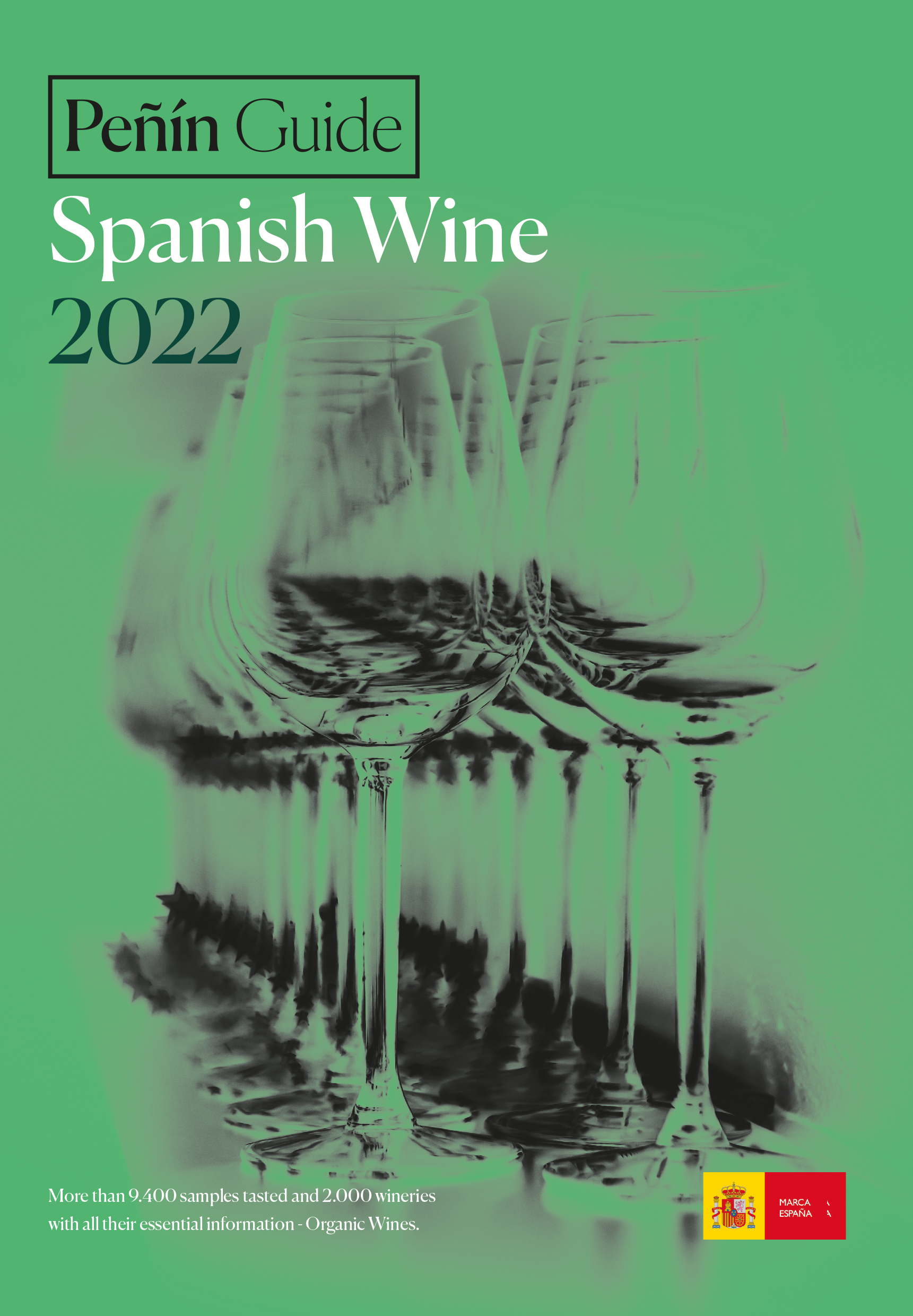
Guía Peñín: Your ultimate source to learn about Spanish Wines

With 9,400 Spanish wine reviews from over 2,000 wineries, Guía Peñín is the most comprehensive guide about Spanish wines. 

I still remember when I first had a copy of this guide in my hands, it was about 20 years ago, I was working for Wines from Spain then, and José’s guide was only published in Spanish and on hard copy. In order to get it, we depended on our Spanish colleagues to bring one from Madrid. Back then, we used this coveted book daily, mostly whenever we wanted to learn about the different Spanish appellations and terroir, to find information about all the wineries, and to check the name of wines and reviews.

The man behind it, José (Pepe) Peñín has dedicated the last 30 years of his life to taste and review Spanish wines, distilled spirits and vermouth, promoting Spanish wines and wine tourism like nobody did before.

Fast forward to 2022 and now this wonderful guide is published and available in 4 different languages, Spanish, German, English and Chinese and his work (over 80,000 wine reviews) is available online on his digital platform @ guiapenin.wine.

For the 2022 edition, José and his team of 4 tasted and reviewed about 10,000 wines. 55% of those were red, 29%  white, 7% sparkling, 6%  rosé and 3% fortified wines. 

José's scoring system divides them in three groups: 

Podium wines for those that received 95-100pts 

Excellent wines from those that received 90-94 pts 

and Very Good wines for those that received 85-89 points.

Last week, during the official launch of Guía Peñín in NY, I had the opportunity to attend a seminar presented by José himself featuring 7 Podium wines that have received between 95-96 pts.

The fine selection included the following:

  • Pere Ventura Gran Vintage Paraje Calificado, Can Bas 2015,  D.O. Cava, 95 pts.

This delicious Cava features 50% Macabeo and 50% Xarel.lo grapes. Paraje Calificado is the equivalent to a Burgundy Grand Cru within the Cava appellation. Completely vinified, using the method Champenoise, with second fermentation inside the bottle, this Cava was also aged on its lees for 42 months. The result is an outstanding, complex and elegant bubbly.

A flight of 4 delicious Tempranillo wines, from the 3 top appellations in Spain: Rioja, Ribera del Duero and Toro:

  • Lalomba Finca Valhonta 2018, D.O.C Rioja, 96 pts

An expressive Rioja made from 100% Tempranillo grapes grown in chalky clay terraces at 650 m. This single vineyard wine was aged for 14 months in oak and 8 months in vat, which delivers a wine full of ripe fruit: black cherry and plum, with delicious spicy notes.

  • Abadia Retuerta Pago Negralada 2016, V.T. Castilla y León,95 pts

A single vineyard 100% Tempranillo, grown at 800 m on gravel soils. This wine was aged for 16 months in new French oak and was one of my favorites of the whole tasting. A fine example of Tempranillo featuring blackberry, cassis and leather notes. Refined and seductive with beautiful soft tannins.

  • Pradorey Elite 2018, D.O. Ribera del Duero, 95 pts

The flagship of this winery and another distinguished single vineyard red, was made from 100% Tempranillo grapes, grown on calcareous soils at 850 m of height. It was also aged for 14 months in new French oak. This  luscious and impressive Ribera del Duero red showcases blackberry, tobacco and licorice notes.

  • Vatan 2018, D.O. Toro, 95 pts

A super Tempranillo wine, made from 100% Tinta de Toro grapes, also from a single vineyard “Finca Los Quemados” featuring sandy soils. This was the biggest of all 4 reds served, and a super powerbomb! Massive in body and texture, it features black currant, licorice and figs with a touch of minerality. Toro usually produces the biggest and beefest Tempranillos from all of Spain.

The last two wines were sweet styles that blew my mind!

  • Vino Dulce de Invierno 2019, Javier Sanz Viticultor, Vino de Mesa, 95 pts

A delicious dessert wine  that is made in tiny quantities. It is made from 80% Verdejo  and 20% Gorda de Moldavia grapes. The sweetness comes from late harvest grapes, grapes that were air dried using the appassimento technique and frozen grapes (in the winery) to emulate the technique used to make ice wines. It has only 10% alcohol, showing a very fragrant nose full of quince, orange marmalade and marzipan aromas and a very unctuous body. Reminiscent of Sauternes or Hungarian Tokay. Unfortunately, this exquisite elixir is not yet sold in the US.

  • Jorge Ordoñez & Co, #2  Victoria Moscatel,D.O. Málaga, 95 pts

A fantastic Muscat of Alexandria wine that is elegant and refined. It was aged on its lees for 8 months. It features a perfumed grapey nose that features candied orange, lychee and honeysuckle notes. Superb!

So, if this summer you plan to learn more about Spanish wines or a wine tour through Spain, buy this wonderful guide! It will surely help you learn more about Spanish grapes, wine styles and its varied terroir.  Salud! or Cheers! Silvina.


#thoughtsoflawina #WineWednesday #penineventnyc #guiapenin

Tuesday, March 8, 2022

Priorat: Wines of Power and Elegance!

Priorat DOQ is a tiny enclave/ appellation that stretches out from the foot of the Sierra of Montsant, in Catalonia, Spain. Though grapes were grown here since the middle ages, Priorat gained international fame, very recently, in 1989, when five producers decided to launch wines made from very old Garnacha (grenache) vines. The five pioneers were René Barbier from Clos Mogador, Carles Pastrana from Costers del Siurana, Joseph Lluis Perez from Mas Martinet, Daphne Glorian from Clos Erasmus and Alvaro Palacios, heir from the Rioja's family Palacios Remondo. The superb wines they made/make, put this appellation in the wine world map and helped Priorat to become a DOCa (Denominación de Origen Calificada) which is the highest quality level in Spain, similar to the Italian DOCG.
                                         
So what is so special about Priorat
The name of this boutique region comes from the word priory, because once upon a time there was a Carthusian monastery here, built by Alfonso II in 1163.  This monastery was known as Scala Dei (God’s stairway to heaven), and precisely it was the monks, as they did in many other parts of the world, who brought the grapes and the winemaking know-how. Nowadays, Scala Dei is the name of a winery owned by world known Cava producer Codorníu, that operates from some of the old monastery buildings.
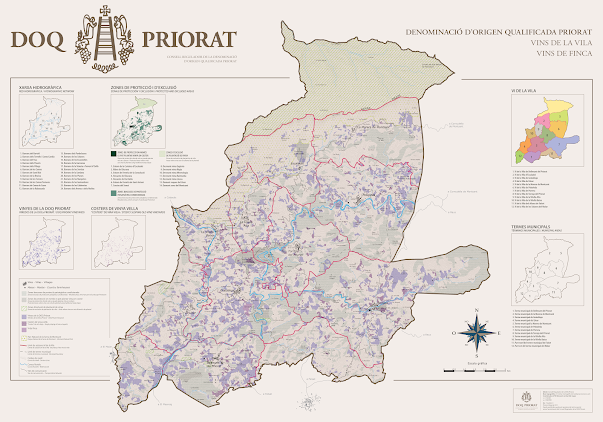
There are 12 distinctive wine villages or zones in Priorat and these are: Bellmunt del Priorat, Gratallops, el Lloar, la Morera de Montsant, Porrera, Poboleda, Scala Dei (monastery), Torroja del Priorat, la Vilella Alta, la Vilella Baixa, Masos de Falset and Solanes del Molar. (see below map courtesy of DOC Priorat)


Stylistically, Priorat wines are age worthy reds, and basically powerbombs! with big bodies and alcohol, plenty of tannins and structure, they feature ripe blackfruit notes, chocolate, wild herbs and mineral aromas. These wines are concentrated and extracted, this is the direct result of very low yielding vines, most of them providing only 5-6 hl/ha. These vines grow in a very special soil called Llicorella, which is a dry, poor, slate and quartz based soil. The climate in Priorat is one of extremes, hot during the day and cool at night, most of the vineyards are distributed around a series of valleys, with high elevations that go up to 900 meters/ 3,000 feet. If you visit Priorat, you will see the vineyards planted on terraces built a long time ago. I still remember when René Barbier drove me through the appellation and warned me before we were about to go down the hill. It felt pretty much like a roller coaster ride to me!

Priorat wines are blends, similar to the ones from the Southern Rhone. They are mostly Garnacha or Carignan based, with small percentages of Merlot, Cabernet Sauvignon, Syrah and native Tempranillo. The blend varies according to the winemaker’s taste, with some of them choosing not to include Carignan at all. Most of the winemakers prefer to age wines in French oak, following the Bordelais tradition, but some use American oak. Both Garnacha and Carignan love the heat so much, they can easily reach high alcohol levels on their own, yielding an average of 15% or more for most wines. But as my title suggests, Priorats are wines of  elegance, meaning you shouldn’t be discouraged by their alcohol, since it is usually very well integrated and balanced. The challenge of this region, if any, is to keep the freshness, so that the wines always remain lively and full of fruit.

Higher end Priorat is usually pricey ($50 and up) but there are plenty of  producers that make affordable wines that are quite good too, like my recommendations below, that I hope you will enjoy soon!

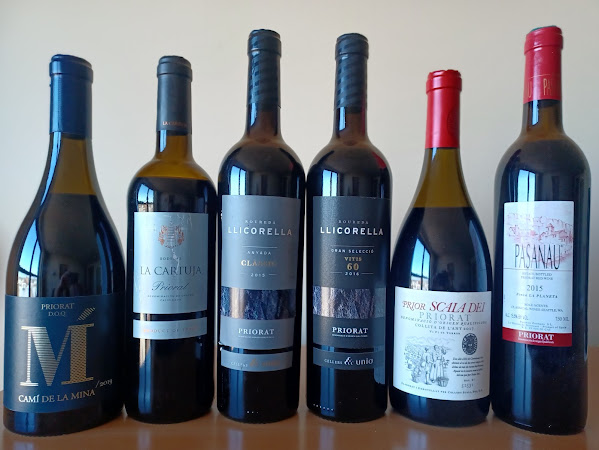
Clos Pachem Cami de la Mina 2018, $19.99
Vinos Atlántico, La Cartuja 2018, $24.99
Cellers Unio Roureda Llicorella Classic 2015, $24.99
Cellers Unio Roureda Llicorella Vitis 60 2016, $31.99
Prior Scala Dei 2017, $29.99
Pasanau Finca La Planeta 2015, $54.99


If you have the $$$ to afford the high end top wines. Here are some of the best I ever tasted:
Alvaro Palacios Finca Dofí 2019, $104
Clos Mogador 2019 $109
Vall Llach 2019, $100

Cheers! Silvina

Remember to subscribe to keep receiving Thoughts of La Wina in your inbox and to follow me in Linkedin and Instagram @Silvinalawina.

#thoughtsoflawina #WineWednesday#spanishwines #prioratwines

Tuesday, December 14, 2021

Value Wines for New Year's Eve

Where did 2021 go? If you are anything like me it probably went too quickly! I think time moves at a different rhythm in post pandemic times.
But, here we are getting ready to celebrate another holiday season, another new year’s eve with masks,  and this time after requesting PCR negative tests from all your guests, it’s time to think about the food and most important the wines.  So, what wines to choose for your holiday party? Believe it or not, I ask myself this question too, something good but not too pricey, so I can buy plenty of bottles for all my guests.  The idea here was to choose some sparkling, whites and reds that will appeal to a large group of people and match with a variety of cold and hot appetizers, without breaking the bank!

So, I decided to allow the many importers, producers and PR companies that have supplied La Wina with samples all through this year to choose for me. I told them “send me wines of your choice below $20 and above all surprise me”. See my selections below, a truly different set of wines, these will be great for all your holiday gatherings and also as gifts too!

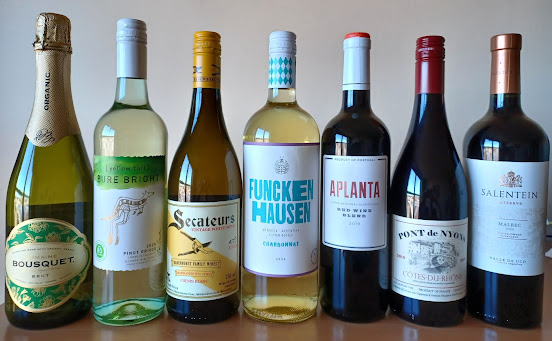
Yellow Tail Pure Bright Pinot Grigio 2020, South Australia

For many years, Yellow Tail has been one of the best selling brands in the world, mostly because  besides being very affordable, they provide something Americans truly love, plenty of Australian fruit and flavor. The Pure Bright line provides something else,  it is a low calorie/ low alcohol wine. A category I never dived into, (normally I tend to eat less so I can drink more calories from my favorite wines). Surprisingly vibrant, this light bodied white shows juicy green apple and passion fruit notes and is only $7.99!

Badenhorst Secateurs Chenin Blanc 2020, Swartland, South Africa
I have a confession to make, I’m a huge fan of Chenin Blanc, and feel it never gets the attention it truly deserves, always living under the shadow of Chardonnay or Sauvignon Blanc. The Badenhorst Secateurs Chenin is flinty, showing nectarine, pineapple and honey aromas. It is made from estate-grown 60 year old unirrigated vines that grow on granitic soils.  A brief aging on its lees adds complexity to this flavorful white. $17.99

Funckenhausen Chardonnay 2020, Mendoza, Argentina
This wine, it’s a blend of 93% Chardonnay with 7% Sauvignon Blanc, from Mendoza, Argentina.  Cold macerated to secure fruitiness and completely fermented in stainless steel tanks. No malolactic fermentation accentuates the nice acidity already present in the fruit. It’s truly a good value, the bottle comes in 1 liter size, and not your usual 750 cl. This medium + body white yields lively pink grapefruit and yellow pear notes. A touch of lemon peel frames the creamy finish. $14.99

Domaine de Bousquet Brut NV, Mendoza, Argentina
It’s New Year’s after all! And I have to include a sparkling wine to toast 2022. This one is made from organic grapes, estate-grown in the Tupungato valley, Mendoza, Argentina.
It’s a blend of 75% Chardonnay with 25 % Pinot Noir, completely fermented in tanks, using the Charmat method, which is the same method used to make Prosecco. Domaine de Bousquet Brut is a certified vegan bubbly that offers enticing green apple, brioche and citrus (lime) aromas. Its fine, pearly mousse adds energy to the finish. $12.99

Aplanta Red Wine Blend 2019, Vinho Regional Alentejano, Portugal

Portugal is the source of many good value/ good quality wines and Aplanta is a very good example of this. This juicy and inviting red is a blend of 70% Aragonez, otherwise known as Tempranillo and 30 % Alicante Bouchet. It features a medium body, saturated with blueberry marmalade and black cherry notes. Velvety textured tannins give away to a supple finish. $10.99

Pont de Nyons Cotes du Rhone 2019, France
I love spicy reds like those from the Cotes du Rhone, they have plenty of pizzazz and personality and match with plenty of food!  This plush red is made from 70% Grenache (from vines averaging 60 + years old) combined with 30% elegant Syrah, grown in soils rich in limestone and clay.  It showcases sweet blackberry notes, with black olives and garrigue aromas that build up to a silky finish. $12.99

Salentein Malbec 2020, Mendoza, Argentina
Ooops! I just realized that I ended up recommending too many wines from Argentina, I guess I can’t deny my roots. The truth is I couldn’t finish without including a fine Malbec, after all, this is what my closest friends get for Christmas every year. 

This red is made from 100 % Malbec grown in the Uco Valley, in the eastern slopes of the Andes. It offers ripe plum, black cherry, sweet tobacco and spicy notes from oak, ending in a polished finish. $19.99


Happy New Year, my dear Winos! May you manifest each and every dream in 2022! Cheers, Silvina.

Remember to subscribe to keep receiving Thoughts of La Wina in your inbox and to follow me on Instagram @Silvinalawina and Linkedin.

#thoughtsoflawina #greatvaluewines #winesfornewyearseve #winewednesday